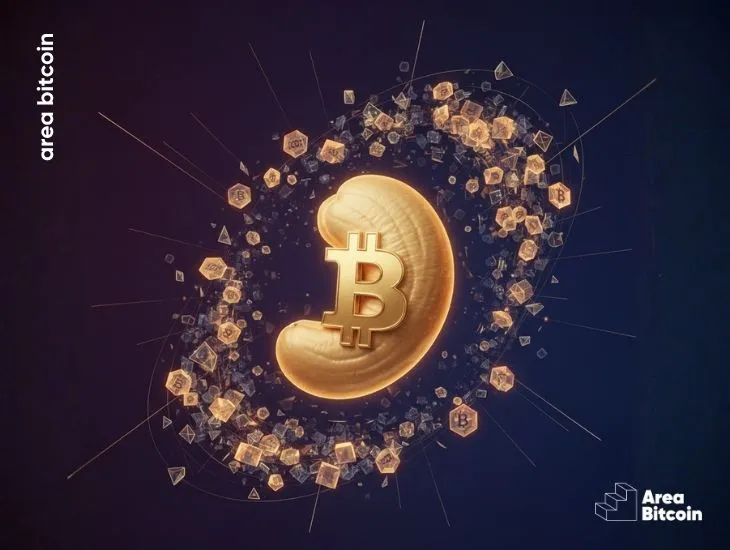
Cashu is a free, open-source eCash (electronic cash) protocol built for Bitcoin. Created by developer Calle, it uses blind-signature cryptography to enable instant, private, and near-free transactions. In practice, it is like having physical cash, but in digital form and integrated with Bitcoin via the Lightning Network.
If you have ever used cash, you know it has a powerful property: no one needs to know who paid whom. No login, no registration, no history tied to your identity. That is what Cashu brings to the digital world. The most interesting part is that it does this without giving up integration with Bitcoin.
In this article, you will understand what Cashu is, who developed the protocol, how it works in practice, the difference between Cashu and eCash, which wallets and apps already use this technology, and why it may be so important for the future of Bitcoin payments.
Let’s dive in.
Topics covered
What is Cashu?
Cashu is an open-source protocol that turns bitcoin into private digital cash. Simple as that.
Think about paying for a coffee with a $10 bill. Nobody knows where that bill came from, how many hands it passed through, or where it goes next. Cashu does exactly that, but with bitcoin. It creates a privacy layer that makes transactions impossible to trace.
In practice, it works like this: you deposit bitcoin (usually via the Lightning Network) into a server called a mint. The mint then creates tokens equivalent to the value you deposited and gives those tokens to you. They are stored on your phone or computer, like digital bills in your pocket.
From there, you can send those tokens to anyone instantly and with no meaningful cost. You can keep them or redeem them back into bitcoin at any time. It is real money, just digital and private.
And here is the most interesting part: the mint does not know who you are. It cannot see who owns each token or track who it was sent to. This is possible thanks to a cryptographic technique called blind signatures, created by cryptographer David Chaum in the 1980s. It is like a bank stamping a bill inside a sealed envelope without ever seeing the serial number.
In short, Cashu takes bitcoin, which has all transactions publicly recorded on the blockchain, and adds a real privacy layer. The result: fast, cheap transactions that no one can trace.
Who created Cashu?
Cashu was created by Calle, known on X as @callebtc, an open-source developer with a PhD in Physics. Calle is also co-creator of Bitchat, the offline messaging app built on Bluetooth and mesh networking.
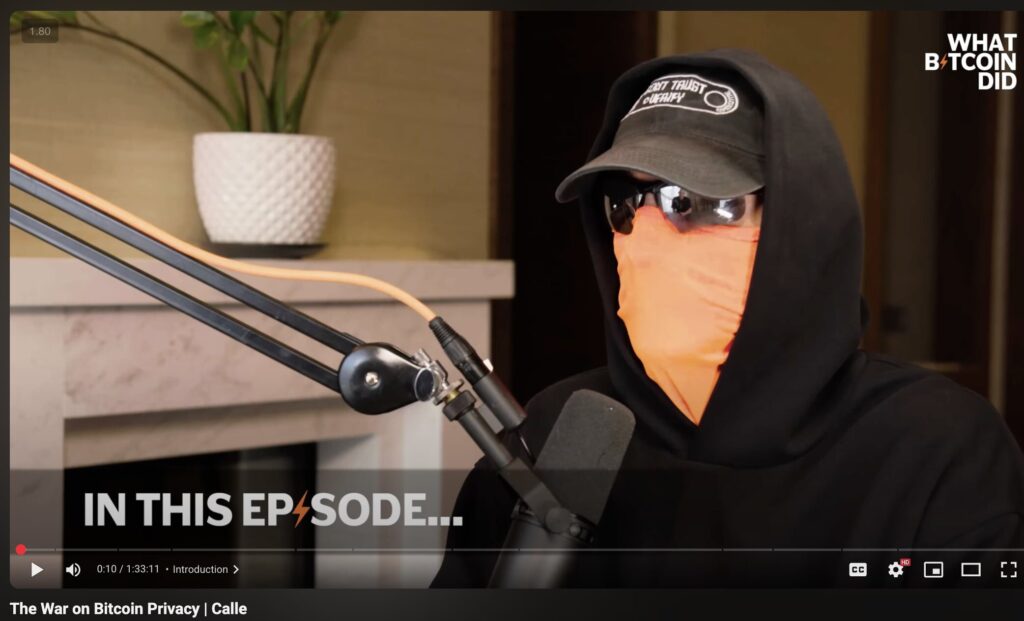
The first commit in the Cashu project was made in September 2022, when Calle published Nutshell, the first wallet and mint implementation of the protocol, written in Python. Since then, the ecosystem has grown quickly, with implementations in TypeScript, Rust, and multiple wallets for iOS, Android, and web.
Calle also created the OpenCash Association, a nonprofit focused on supporting the sustainable development of open-source digital cash projects using the Cashu protocol.
How does this protocol work?
To understand Cashu, let’s use a simple analogy.
Imagine you go to a currency exchange and swap $100 for casino chips. Those chips represent value. You can use them, give them to a friend, or exchange them back for money. The difference is that, in Cashu, the exchange house (mint) does not know which chips are yours.
Technically, the process works in three steps:
1. Deposit (Minting)
You send bitcoin to the mint via the Lightning Network. The mint receives the payment and creates eCash tokens signed with its private key. Before signing, tokens go through a blinding process, where the mint signs without knowing the exact token content.
2. Transfer
With eCash tokens on your device, you can send them to anyone. The transfer is peer-to-peer: copy and paste the token string or scan a QR code. No internet is required at the moment of transfer. The receiver gets the token and redeems it at the mint, which verifies the signature, invalidates the old token, and issues a new one.
3. Redemption (Melting)
When you want to convert tokens back to bitcoin, you do the reverse. You present the tokens to the mint, it verifies the signature, destroys the tokens, and sends the equivalent bitcoin to your Lightning wallet.
The cryptography behind it
Cashu uses BDHKE (Blind Diffie-Hellman Key Exchange). In simple terms:
- The mint publishes its public key.
- The user (for example, Alice) chooses a random secret and blinds it mathematically before sending it to the mint.
- The mint signs the blinded token and returns it.
- The user removes the blinding and gets a valid signature that the mint cannot trace.
- When Alice sends the token to Carol, Carol presents it to the mint for verification, and the mint confirms it without knowing the token came from Alice.
Result: instant transactions, no significant fees, and full privacy.
What is the difference between Cashu and eCash?
This is a common question.
eCash (or Chaumian eCash) is the concept of electronic money invented by David Chaum in the 1980s. It is the theoretical idea of using blind signatures to create anonymous digital tokens that behave like physical cash.
Cashu is a modern implementation of that concept, integrated with Bitcoin. In other words, Cashu is eCash in practice, built on Bitcoin and the Lightning Network.
The big difference is historical: in the 1990s, Chaum’s eCash depended on centralized banks (like DigiCash). It failed because it required a trusted issuer and demand for digital payments was still low.
Cashu addresses this in two ways:
- Anyone can run a mint, so it does not depend on banks or companies.
- Tokens are backed by Bitcoin, not by government-controlled fiat.
eCash vs Cashu (quick comparison)
The table below makes the differences easier to visualize:
| eCash | Cashu | |
|---|---|---|
| Year | 1983 (concept) | 2022-present |
| Backing | Fiat currency (USD) | Bitcoin (via Lightning) |
| Who runs the mint | Licensed banks | Anyone |
| Code | Proprietary | Open source |
| Privacy | Blind signatures | Blind signatures (BDHKE) |
| Interoperability | None | Lightning Network |
| Status | Concept lives on in Cashu, Fedimint, and others | Active and growing |
Cashu vs Fedimint: what is the difference?
Another protocol often compared to Cashu is Fedimint. Both implement Chaumian eCash for Bitcoin, but with different custody models:
- Cashu uses a single mint. One entity operates the mint, signs tokens, and holds the corresponding bitcoin. It is simpler and faster to set up.
- Fedimint uses a federated model. Multiple independent parties operate the mint together using multisig. No single entity controls funds.
In practice, Cashu is ideal for smaller applications, experiments, app integrations, and personal use, while Fedimint is better suited for communities and groups that want stronger collaborative custody.
They are not direct competitors. They complement each other and solve different problems within the Bitcoin ecosystem.
Cashu and the Lightning Network
Cashu and the Lightning Network work together in a complementary way.
Lightning is Bitcoin’s fast payment layer, allowing near-instant transactions with low fees. Cashu uses Lightning as the bridge between on-chain Bitcoin and private eCash.
It works like this:
- To enter Cashu: you pay a Lightning invoice and receive eCash tokens.
- To leave Cashu: you present tokens and receive a Lightning payment.
- Between mints: if someone from one mint pays someone on another mint, payment is routed via Lightning automatically.
This solves one of eCash’s biggest challenges: interoperability. Even with many different mints, they can transact with each other through Lightning, forming a global network of private payments.
Cashu also adds something Lightning alone does not provide: real privacy. On Lightning, routing nodes can observe amounts and route details. In Cashu, transactions between users of the same mint are opaque.
Wallets and apps that use Cashu
The Cashu ecosystem has grown quickly since 2022. Today, many wallets and apps support the protocol across mobile and web.
Mobile wallets
- Macadamia (iOS, Swift)
- Sovran (iOS)
- Minibits (Android)
- eNuts (Android and iOS, community-built)
Web wallets (PWA)
- Cashu.me (official web wallet by Calle; supports Bitcoin and USD, seed backup, offline send/receive, animated QR codes, mint discovery via Nostr)
- Nutstash (web wallet with multi-mint support and token transfer via Nostr)
On-chain/Lightning wallets with Cashu integration
- Blitz
- Coinos
- Voltz
- Zeus
CLI tools
- Nutshell (reference Python implementation; wallet and mint via command line)
- CDK Wallet (Rust CLI wallet)
Projects integrating Cashu
- Bitchat (offline Bluetooth messenger with native Cashu wallet integration)
- BTCNutServer (BTCPay Server plugin for Cashu token payments)
- npub.cash (receive funds via Lightning addresses on Nostr using Cashu mints)
- Numo (Point-of-Sale app that accepts Cashu and Lightning)
- hashpool (mining pool using eCash for share representation without account signup)
- Athenut (privacy-preserving search with Cashu payments)
- TollGate (turns WiFi routers into decentralized internet providers using Bitcoin and eCash)
- routstr (LLM API marketplace using Cashu tokens)
Cashu and Nostr
Cashu has a natural relationship with Nostr, the decentralized communication protocol. Several Cashu wallets support sending and receiving tokens via Nostr, and npub.cash allows Nostr users to receive Lightning payments through a Cashu mint.
This pairing makes sense: Nostr already uses Lightning for zaps, and Cashu adds a privacy layer that Lightning alone does not provide. Wallets like Nutstash and Cashu.me already support mint discovery and token exchange directly through Nostr.
Cashu advantages
Cashu offers several advantages compared to traditional payment systems and even on-chain Bitcoin transactions:
1. Real privacy
The mint does not keep account databases or transaction history. Thanks to blind signatures, it cannot link a deposit to a spend. This is fundamentally different from banks, exchanges, or Bitcoin’s public blockchain.
2. Instant transactions
eCash payments are final and instant. No blocks to wait for, no pending confirmations.
3. Near-zero fees
Transactions between users of the same mint have no fee. The only fees are Lightning fees when depositing or redeeming bitcoin, and those are usually very low.
4. Works offline
eCash tokens are bearer tokens. They can be transferred offline via QR code, NFC, Bluetooth, or even paper. The receiver only needs to be online to verify or redeem at the mint.
5. Open source and interoperable
Cashu is fully open source and its specs are public. The specifications are called NUTs (Notation, Usage, and Terminology). Any developer can build a compatible wallet or mint.
6. Programmable
Cashu tokens support advanced spending conditions such as P2PK and HTLCs, enabling conditional payments and simple smart contracts.
Limitations and trade-offs
Like any technology, Cashu has limitations:
1. Trust in the mint
This is the main trade-off. When you deposit bitcoin into a Cashu mint, you trust that mint to honor token redemption. If it disappears or acts maliciously, you may lose funds. For that reason, do not store large amounts in eCash. Use it for everyday transactional value, like cash in a physical wallet.
2. Not externally auditable
Because of privacy, you cannot externally audit how much eCash a mint issued. In theory, a mint could issue more tokens than it has in bitcoin reserves. This is an inherent challenge in any eCash system.
3. Not full self-custody
Cashu is delegated custody, not full self-custody. Your tokens are bearer tokens, but the underlying bitcoin is held by the mint. For larger amounts, use self-custody wallets.
4. Mints can face regulation
Depending on jurisdiction, running a mint may attract regulatory attention, since it involves custody of third-party bitcoin. The ecosystem is still working through this challenge.
How to use Cashu in practice (step by step)
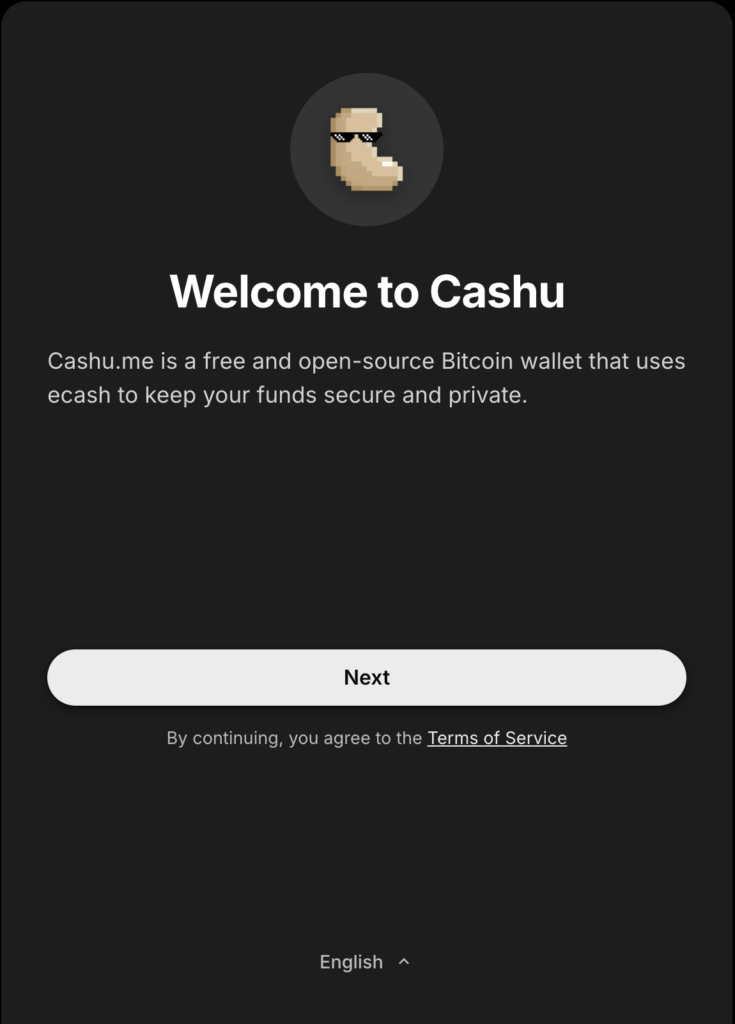
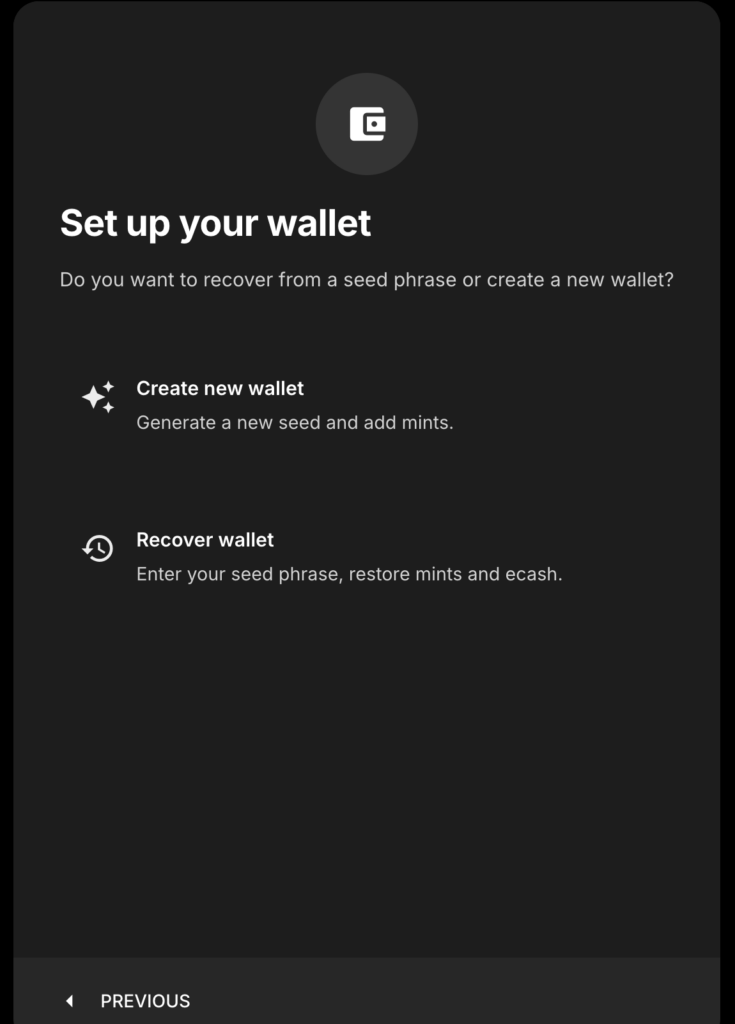
Want to try Cashu? The easiest way is the Cashu.me web wallet.
Step 1: Access the wallet
Open cashu.me on your phone or computer browser. It works as a PWA, so you can install it on your home screen like a native app.
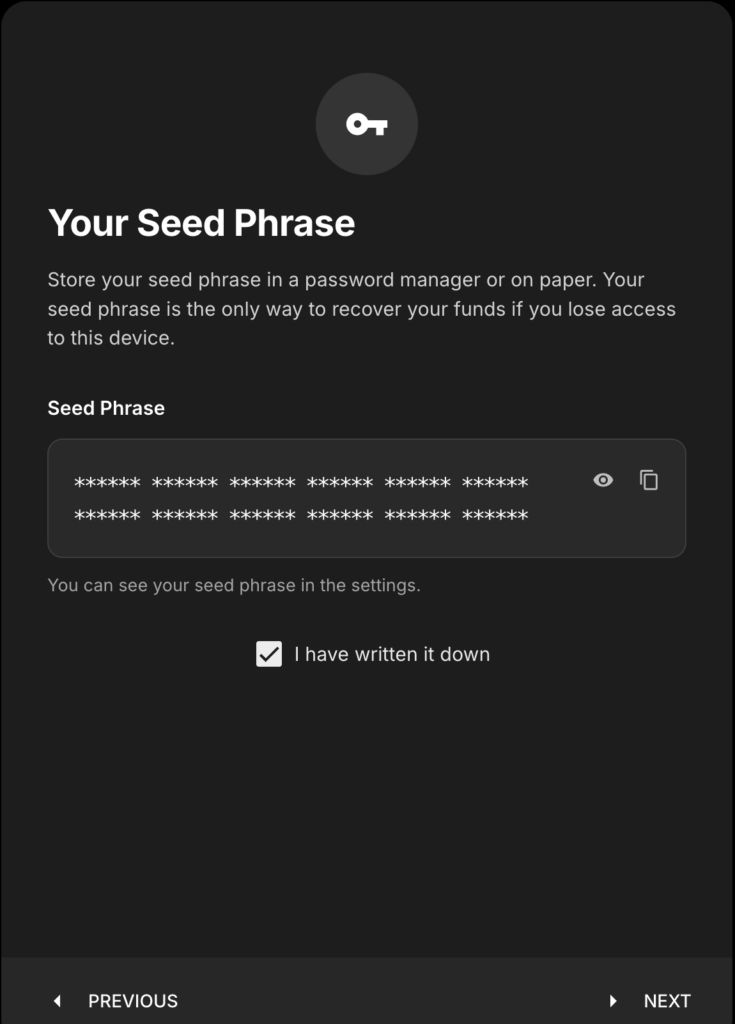
Step 2: Choose a mint
The wallet comes with a default mint. You can add others or discover new ones through Nostr. Remember: your chosen mint is the one custodying your bitcoin, so choose one you trust.
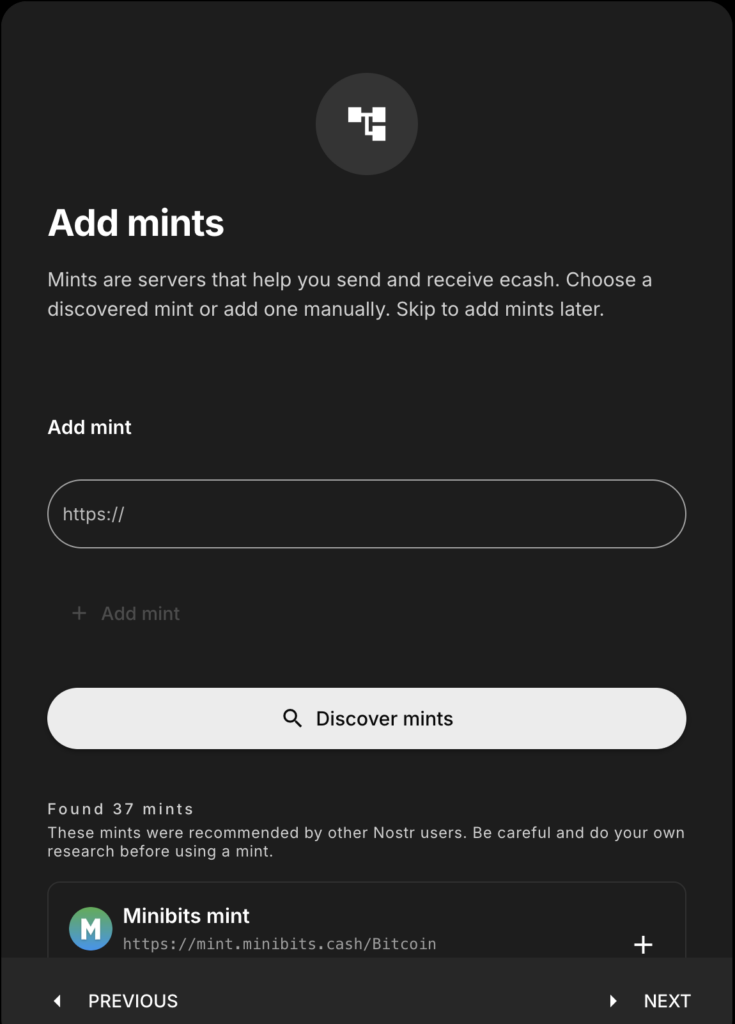
Step 3: Deposit bitcoin
Click Receive and choose Lightning. The wallet generates an invoice you can pay from any Lightning wallet. Once confirmed, your eCash tokens appear in balance.
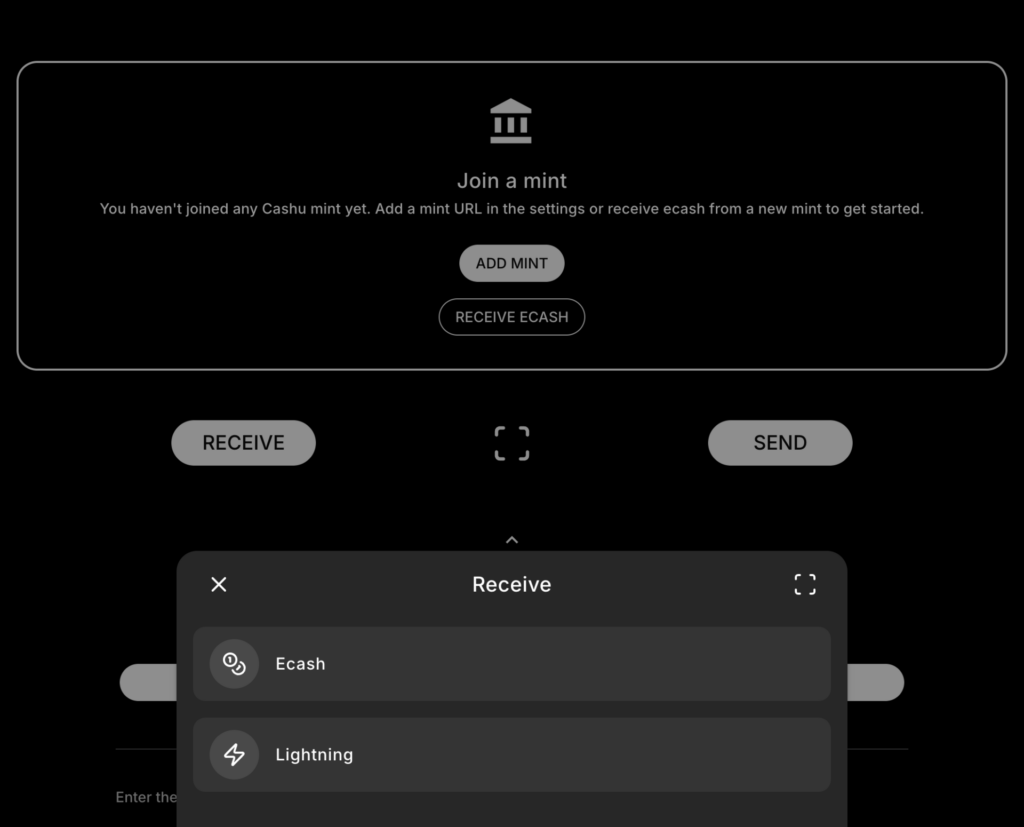
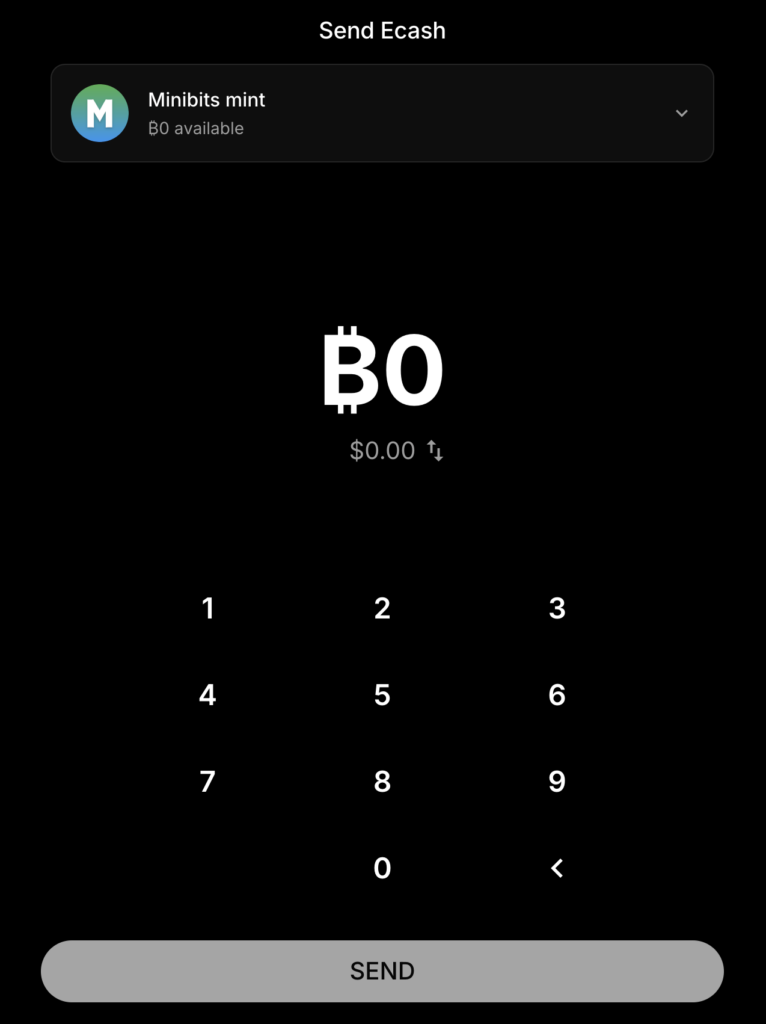
Step 4: Send eCash
Click Send, enter amount, and choose method. The receiver can redeem in any compatible Cashu wallet.
Step 5: Redeem to Lightning
To convert back to bitcoin, paste a Lightning invoice into your Cashu wallet. It pays using your eCash tokens.
NUTs: Cashu protocol specifications
Cashu’s technical specs are called NUTs (Notation, Usage, and Terminology). They describe all key parts of the protocol: token creation, transfer, verification, and redemption.
NUTs are public GitHub documents and ensure compatibility across implementations in Python, TypeScript, Rust, and more.
Development libraries include:
- Nutshell (Python, original reference)
- cashu-ts (TypeScript)
- CDK, Cashu Development Kit (Rust)
If you are a developer, you can build your own wallet or mint using these libraries.
Cashu mints: how they work
A mint is the core of the Cashu system. It is the server that custodies bitcoin and issues eCash tokens. The three main mint implementations today are:
- Nutshell (Python, supports PostgreSQL and SQLite)
- mintd (Rust, part of CDK)
- Nutmix (Go)
Anyone can run their own mint with a server, a Lightning node, and the software. Mints are independent, and users choose which one to trust, with one key difference from traditional banks: the mint does not know who you are.

Cashu and privacy: why it matters
We live in an era where every digital transaction leaves a trace. Banks, fintechs, exchanges, and even Bitcoin’s blockchain record activity. Tools like Silent Payments and CoinJoin help, but they have limits.
Cashu takes a different approach: instead of trying to hide transactions on a public ledger, it records nothing at the user-account level. The mint has no account database, no stored transaction history, and no knowledge of who paid whom.
This is especially relevant for:
- Micropayments: paying for an article, search, or coffee without creating a permanent data trail.
- Protection against hacks: if user data is not stored, there is less data to leak.
- Censorship resistance: in authoritarian contexts, private transactions may be critical.
As cypherpunks say: privacy is not about having something to hide, it is about having the right to choose what to reveal.
The future of Cashu
The Cashu ecosystem is growing quickly. Since its first commit in 2022, the project now has many repositories, multi-language libraries, wallets on major platforms, and a growing open-source community.
Developments worth watching:
- Cashu in Bitchat: native eCash wallet integration for phone-to-phone bitcoin transfer over Bluetooth, without internet.
- eCash for AI: projects like routstr already use Cashu for API micropayments without registration.
- Web payment standard: Cashu tokens embedded in HTTP requests as a potential new micropayment pattern.
- Mining without accounts: hashpool uses eCash to represent mining shares without pool accounts.
Cashu is not trying to replace on-chain Bitcoin or Lightning. It is an additional layer focused on a specific need: fast, cheap, truly private digital payments.
Frequently Asked Questions
What is Cashu?
Cashu is a free, open-source eCash protocol built for Bitcoin. It enables instant, private, and near-free transactions with blind-signature cryptography. Tokens stay on your device and can be sent to anyone.
Is Cashu secure?
Cashu’s cryptography is solid and based on decades of research. The main risk is custody: tokens depend on the mint honoring redemption. Use Cashu for small day-to-day amounts, and use self-custody cold storage for larger holdings.
What is the difference between Cashu and Bitcoin?
Bitcoin is a decentralized digital money network with a public blockchain and full self-custody. Cashu is a privacy layer on top of Bitcoin that uses eCash for fast, private payments. Cashu complements Bitcoin rather than replacing it.
Who created Cashu?
Cashu was created by Calle (@callebtc), an open-source developer with a PhD in Physics, co-creator of Bitchat, and founder of OpenCash Association.
What is the difference between Cashu and Fedimint?
Both implement Chaumian eCash for Bitcoin. Cashu usually runs as a single mint model, while Fedimint uses a federated multisig model. Cashu is simpler; Fedimint is generally stronger for shared custody setups.
Can I lose my Cashu tokens?
Yes. If a mint goes offline or disappears, you can lose eCash held there. You can also lose tokens if you lose device access without seed backup. Use Cashu for small balances.
How can I try Cashu?
The easiest way is to open cashu.me in a browser, choose a mint, deposit a small amount of sats via Lightning, and start sending and receiving eCash. No sign-up, email, or personal data required.
Does Cashu work offline?
Partially. eCash tokens can be transferred offline via QR, text, Bluetooth, and similar methods. But depositing, redeeming, and mint-side verification require internet access.
Related reading
- What is Bitcoin?
- eCash: A Game Changer in Fintech
- David Chaum: Meet the Creator of eCash
- Nostr: learn about the censorship-resistant X!
- Silent Payments: A New Era of Privacy in Bitcoin
- Is Bitcoin Anonymous?
Conclusion
At its core, Cashu delivers on a long-standing vision that began in 1983 with David Chaum: digital money that behaves like physical cash. Private, instant, and without intermediaries tracking every transaction.
The difference now is that we have Bitcoin as the reserve asset, Lightning as infrastructure, and a vibrant open-source ecosystem building practical tools.
If you are exploring Bitcoin, understanding Cashu means understanding the next step in digital payment evolution. Try it, test with small amounts, and see how it works in practice.
See you next time. OPT OUT.
Share on your social networks:

Area Bitcoin is an educational Bitcoin school that aims to accelerate the financial and intellectual sovereignty of all individuals.

Did you like this article? Consider buying us a cup of coffee so that we can keep writing new content! ☕